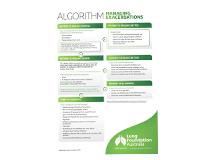




X2. COPD acute exacerbation plan
X2.1 Initial
assessment of severity
Assessment of severity of the
exacerbation includes a medical
history, examination, spirometry
and, in severe cases (FEV1 < 40%
predicted), blood gas measurements,
chest x-rays and
electrocardiography. Patients should
be provided with and bring a summary
of their medical problems and
treatment (eg, a personal health
record). If available, results of
previous stable lung function tests
and arterial blood gas measurements
are invaluable for comparison.
-
Spirometry:
Unless confused or comatose,
even the sickest of patients can
perform an FEV1 manoeuvre. An
FEV1 less than 1.0 L (or < 40%
predicted) is usually indicative
of a severe exacerbation in
patients with moderate COPD. For
patients with stable levels
below these values (ie, severe
COPD), the most important signs
of a severe exacerbation will be
worsening hypoxaemia, acute
respiratory acidosis (carbon
dioxide retention), or both.
-
Arterial
blood gases:
Arterial blood gas
levels should be measured if the
FEV1 is less than 1.0 L or less
than 40% predicted, or if there
are signs of respiratory failure
or cor pulmonale. Values
obtained while breathing room
air are the most useful for
assessing ventilation–perfusion
inequality. A PaO2 less than 60
mmHg (8 kPa) indicates
respiratory failure, while a
PaCO2 greater than 45 mmHg
indicates ventilatory failure. A
pH <7.20 indicates acute
respiratory failure warranting
consideration for assisted
ventilation.
-
Chest
x-ray and electrocardiogram:
These help to identify
alternative diagnoses and
complications, such as pulmonary
oedema, pneumothorax, pneumonia,
empyema, arrhythmias, myocardial
ischaemia and others.
X2.2 Optimise treatment
An acute exacerbation of COPD may
involve an increase in airflow
limitation, excess sputum
production, airway inflammation,
infection, hypoxia, hypercarbia and
acidosis. Treatment is directed at
each of these problems.
-
Bronchodilators:
Inhaled beta-agonist (eg,
salbutamol, 400–800 mcg; terbutaline, 500–100
mcg) and
anticholinergic agent
(ipratropium, 80 mcg) can be
given by pressurised metered
dose inhaler and spacer, or by
jet nebulisation (salbutamol,
2.5–5 mg; terbutaline, 5 mg;
ipratropium, 500 mcg). The dose
interval is titrated to the
response and can range from
hourly to six-hourly.
-
Glucocorticoids:
Oral glucocorticoids hasten
resolution and reduce the
likelihood of relapse. Up to two
weeks' therapy with prednisolone
(40–50 mg daily) is adequate.
Longer courses add no further
benefit and have a higher risk
of side effects.
-
Antibiotics:
Antibiotics are given
for purulent sputum to cover for
typical and atypical organisms.
-
Controlled
oxygen therapy:
This is indicated in patients
with hypoxia, with the aim of
improving oxygen saturation to
over 90% (PaO2 > 50 mmHg, or 6.7 kPa). Use nasal prongs at
0.5–2.0 L/minute or a venturi
mask at 24% or 28%. Minimise
excessive oxygen administration,
which can worsen hypercapnia.
-
Ventilatory assistance:
This is indicated for
increasing hypercapnia and
acidosis. Non-invasive positive
pressure ventilation by means of
a mask is the preferred method.
In exacerbations of COPD, the
immediate bronchodilator effect is
small, but may result in significant
improvement in clinical symptoms in
patients with severe obstruction.
Studies of acute airflow
limitation in asthma indicate that
beta-agonists are as effectively
delivered by metered dose inhaler
and spacer as by nebuliser. This may
be applicable to patients with COPD,
although no direct evidence exists.
An adequate dose should be used. The
dose equivalent to 5 mg of salbutamol delivered by nebuliser is
8–10 puffs of 100 mcg salbutamol by
metered dose inhaler and spacer.
Airflow in the nebuliser should be 6
L per minute or higher to achieve an
aerosol. Avoid using high-flow
oxygen, which may worsen carbon
dioxide retention. High doses of
beta-agonists may induce hypokalaemia
and predispose to cardiac
arrhythmias.
Few studies have examined the use
of ipratropium bromide in acute
exacerbations of COPD.245,246 One
study which compared the
effectiveness of ipratropium bromide
with a beta-agonist showed that each
drug produced a small but
significant improvement in pulmonary
function.245 Inhaled ipratropium
bromide also produced a small but
significant increase in PaO2
(average, 6 mmHg, or 0.8 kPa) within
30 minutes of its delivery.
Hospital management of a
severe exacerbation usually
includes nebulised beta-agonist
bronchodilator (eg, salbutamol,
terbutaline), given continuously in
extremely unwell patients and
intermittently in others. This will
usually be delivered by means of
high flow air. An anticholinergic
agent (ipratropium bromide) may be
delivered together with the
nebulised beta-agonist in patients with
severe exacerbations (triage
categories 1 and 2) or when response
to beta-agonists alone is poor.
However, a systematic review247
that included four randomised
controlled trials did not
demonstrate any additional benefit
on FEV1 of the
combination of an anticholinergic
compared with beta2-agonist
alone. [evidence level I] Nebulised medications can also be
administered through the assisted
ventilation circuit if required.246
The mode of delivery should be
changed to a metered dose inhaler
with a spacer device or a dry powder
inhaler within 24 hours of the
initial dose of nebulised
bronchodilator, unless the patient
remains severely ill.248,249
The use of methylxanthines (oral
theophylline and IV aminophylline) in the management
of acute exacerbations of COPD has
diminished because of their
potential for toxicity250-254.
Methylxanthines can also provoke a
number of arrhythmias including
multifocal atrial tachycardia.33 A systematic review of four Randomised Controlled Trials found a
transient increase of 101ml in FEV1
after three days and a 4-6 fold
increased risk of nausea and
vomiting255[evidence level I]. The routine use
of aminophylline is not recommended
for for non-acidotic acute exacerbations [evidence level II].256
Bacterial infection may have
either a primary or secondary role
in about 50% of exacerbations of
COPD.230,233,238,258
Haemophilus
influenzae, Streptococcous
pneumoniae and Moraxella catarrhalis
are most commonly
involved.230,232,237 Mycoplasma
pneumoniae and Chlamydia pneumoniae
are seen relatively
frequently.230,236 As lung function
deteriorates (FEV1 < 35%),
Pseudomonas aeruginosa and
Staphylococcus aureus are often
encountered.230,232,238
Two systematic reviews have
found similar benefits for
antibiotic treatment over
placebo in severe acute
exacerbations requiring
hospitalisation, despite
including different studies.
Ram et al260,
including mostly
hospital-based studies,
found a significant decrease
in mortality (RR 0.23, 95%
CI 0.10 to 0.52) with a NNT
of 8 (95% CI 6 to 17). Puhan
et al261
also found a decrease in
mortality of their sub-group
analysis of severe
exacerbations requiring
hospitalisation (OR 0.20,
95% CI 0.06 to 0.62) with a
NNT of 14 (95% CI 12 to 30).
Both systematic reviews also
found a significant decrease
in treatment failure.
Although Puhan did not
combine the results of
adverse drug effects due to
heterogeneity, Ram found
antibiotic treatment
increased adverse events,
most notably diarrhoea (RR
2.86, 95% CI 1.06 to 7.76)
with a NNH of 20 (95% CI 10
to 100). The effect of
antibiotics in the general
practice setting is unclear.
Puhan found no significant
benefit for treatment
failure in mild and moderate
exacerbations treated
outside the hospital setting
(OR 1.09, 95% CI 0.75 to
1.59).

A systematic review of RCTs has
confirmed the overall benefit of
antibiotics given for at least five
days in acute exacerbations
(although most of the data is from
the hospital setting).260
Antibiotics for increased cough and
sputum purulence decreased
mortality, treatment failure and end
of treatment sputum purulence at a
cost of an increased risk of
diarrhoea. A significant decrease in
mortality (RR 0.23; 95% CI 0.10 to
0.52) was found, meaning 8 (95% CI 6
to 17) people needed antibiotic
treatment to prevent one death.
Treatment increased adverse events,
most notably diarrhoea (RR 2.86; 95%
CI 1.06 to 7.76), meaning antibiotic
treatment in 20 (95% CI 10 to 100)
people would result in one
additional episode of diarrhoea.
Unfortunately, these data are
limited by participant numbers and
setting, the majority of studies
being performed in the hospital
setting. Generalisability,
especially to the primary care
setting where most exacerbations are
seen, is unclear.
Therapeutic guidelines:
antibiotic262
recommend the use of oral agents
such as doxycycline or amoxycillin
(alternatively, erythromycin or
roxithromycin). If patients do not
respond, or if resistant organisms
are suspected, amoxycillin–clavulanate
should be prescribed. If pneumonia,
pseudomonas or staphylococci is
suspected, appropriate antibiotics
should be used.
Typically, a course of treatment
should be over seven to 10 days. A
response is usually seen within
three to five days, and a change of
antibiotic should be considered if
the response is unsatisfactory. If
parenteral administration was
commenced, oral treatment should be
substituted within 72 hours.
Radiologically proven pneumonia
in patients with COPD, especially in
those who have been frequently
hospitalised, may not be restricted
to the above organisms.
Gram-negative organisms, Legionella
spp. and even anaerobic organisms
may be responsible. Initial empiric
antibiotic therapy should be
tailored according to clinical and
radiographic criteria.
A randomised controlled
trial of systemic glucocorticoids
for acute exacerbations of COPD
showed a moderate improvement in
clinical outcomes.264 Maximum
improvement was gained within two
weeks of therapy, and prolonging the
course of treatment thereafter did
not result in further benefit. An
important side effect was hyperglycaemia, often sufficiently
severe to warrant treatment. Blood
glucose levels should be monitored.
Oral or parenteral glucocorticoids
are recommended for treating acute
exacerbations of COPD [evidence level I]. The optimal dose has not
been established, but 30–50 mg
prednisolone daily is sufficient for
most patients. If intravenous
therapy was commenced, this should
be changed to oral therapy within 48
hours. An updated systematic
review of systemic corticosteroids
for acute exacerbations showed that
it would have been necessary to
treat nine patients (95% CI 6 to 14)
with systemic corticosteroids to
avoid one treatment failure in this
time period. Overall, one extra
adverse effect occurred for every
six people treated (95% CI 4 to 10).
The continued use of inhaled
corticosteroids and the
administration technique should be
reviewed. At discharge, therapy with
oral prednisolone (25–37.5 mg daily)
may be continued but the optimal
duration is unknown.
Tapering of glucocorticoid therapy
is not necessary after short-term
administration. However, patients
who have taken glucocorticoids for
more than three consecutive weeks
may have adrenal suppression,264,265and their glucocorticoid therapy
should not be ceased abruptly.
Patients on long-term oral
steroid therapy (≥ 7.5 mg
prednisolone daily for more than 6
months) are at risk of developing
osteoporosis. Prevention and
treatment of steroid-induced
osteoporosis should be considered.